Why pursue a Pharm.D. concentration in geriatrics
March 7, 2026
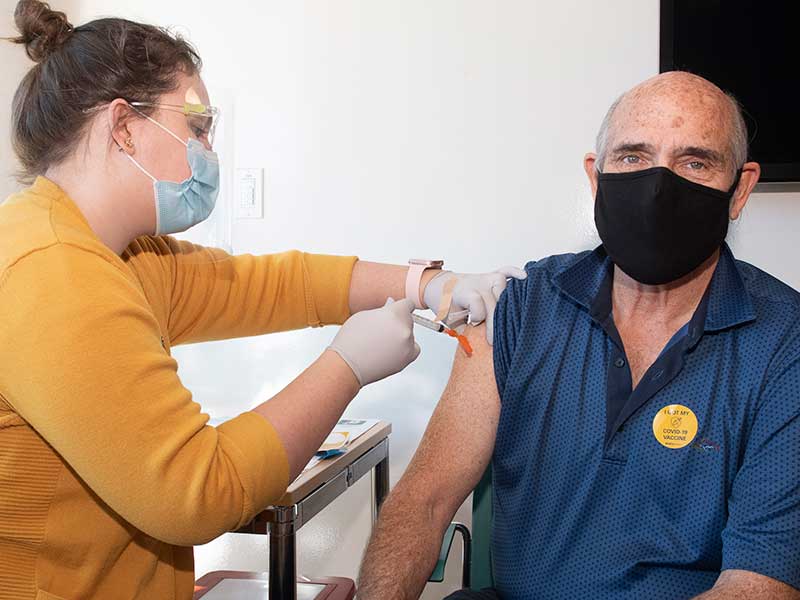
At 55 million individuals, older adults make up more of the U.S. population (16.8%) than ever before. The U.S. Census Bureau in 2023 reported that the population of adults age 65 and over grew by 38.6% from 2010-2020, the fastest growth rate since 1880-1890. And with this large and growing population comes unique medication and health care needs that pharmacists are poised to support.
Elvin Price, Pharm.D., Ph.D., an associate professor in the Department of Pharmacotherapy and Outcomes Science at VCU School of Pharmacy, knows the needs of this population well. Price serves as director of VCU School of Pharmacy’s Geriatric Pharmacotherapy Program, which is nationally recognized for education, practice innovation and research advancing the field of pharmacotherapy for older adults. And, he and his pharmacy, nursing and health professional colleagues at VCU’s Mobile Health and Wellness Program work closely with older adults throughout the Richmond region, offering wellness coaching, care coordination and support with long-term health conditions.
Now, Price has championed the development of the new geriatrics concentration for Pharm.D. students. The new track for future pharmacists is a natural fit for VCU School of Pharmacy, especially given the school’s long history as a leader in pharmacy training and patient care for older adults.
VCU has the first and only Pharm.D. program to be awarded an Academy for Gerontology in Higher Education (AGHE) designation as a Program of Merit for Health Professions from the Gerontological Society of America. This designation stems, in part, from the school’s long-running Pharm.D./Certificate in Aging Studies dual degree program in partnership with VCU College of Health Professions’ Department of Gerontology.
The new geriatrics concentration can offer many paths for VCU’s future pharmacists, Price says.
“It’s easier for you to go from having spent some focus on championing safety and efficacy in one population – to then go and broaden it,” Price says. “If you can do that for older persons – you can think about pharmacodynamics and pharmacokinetics and adverse events – then you can expand it out to those that are a little bit younger in their 50s. And then, if you wanted to go pediatrics, you can even expand it down further because you have this general sense of how drugs work in people, how we get great outcomes, instead of sub-optimal outcomes, in treating patients across age groups.
“If you can demonstrate that you have the capacity to think across those areas, then it makes you a good candidate for doing it in any population or sub-specialty, like oncology. It just shows the capacity to develop clinical expertise and great communication, and these are the skills employers are looking for.”
Price recently spoke with VCU School of Pharmacy News about what pharmacy students can expect to learn in the geriatrics concentration and how that knowledge and experience will benefit them as they enter their pharmacy career.
What opportunities will students have in the coursework for this concentration that will set them apart?
One of the things that this concentration offers is an opportunity to gain clinical expertise in an area with a population that is expanding. You’ll have an opportunity to gain expertise in geriatrics on the clinical front. This concentration helps with preparing you for residency opportunities. Whether you are thinking about the classic PGY-1 internal medicine-focused residencies or you’re thinking about going directly into an ambulatory care residency, the concentrated clinical expertise that you will gain in geriatrics from these electives gives you an opportunity to be able to tell better clinical stories or better stories for ambulatory care that should help to make you more competitive for residency-based opportunities or opportunities in other areas like community pharmacy. You’ll have additional clinical expertise that gives you experience you can talk about in job interviews across the pharmacy profession.
If you had to choose, what’s one class in this concentration that you would want to highlight?
I would do two. One would be the geriatrics elective, which covers lots of topics that are unique to older adults. It’s team-taught so you’ll have access to lectures from geriatrics experts, including Krista Donohoe, Pharm.D., and Emily Peron, Pharm.D. By having access to lectures from these faculty, you also have access to their perspectives and all of the experiences that they bring from their clinical practices and from their previous training in different environments – environments that you may not have had direct access to, but you’ll have the access to the experiences because of where our faculty have trained.
The other course I would say would be the Geriatrics APPE. The Geriatrics APPEs are clinical electives that place you in the practice environment with one of the geriatrics faculty members, and you can see them solve problems for community-dwelling older adults in their practice. To see it for yourself and contribute in a clinical setting serves as a capstone for the experience of learning theory around geriatrics.
What type of environments could fourth-year students spend time in during the Geriatrics APPE rotation?
An APPE rotation with Kristin Zimmerman, Pharm.D., for example, would take place in a comprehensive geriatrics clinic at VCU Health. That would be an experience in a team-based setting with geriatricians, nurse practitioners and pharmacists working together on comprehensive complex cases of community-dwelling older adults.
Ericka Crouse, Pharm.D., leads a geriatrics service in inpatient geriatric psychiatry (geri-psych) so you’d be dealing with unique challenges associated with helping to treat psychiatric conditions for older persons and navigating the nuances that only a psychiatric pharmacy expert like Dr. Crouse could give you in a setting like that.
Then another option is in the Mobile Health and Wellness Program, where Dr. Donohoe, Dr. Peron and I work as a team with faculty from nursing, social work and other health professions. You would be paired with students from nursing, medicine, occupational therapy, physical therapy, social work –students and faculty from those programs. We have a variety of experiences we can offer to align with the goals that you as a student have for your career.
What internship or job opportunities could students have with this concentration?
We have two formal internships that our group offers. One of those internships is called the McFarlane Scholars Program, supported by a gift from VCU School of Pharmacy alumni Ronald and Nancy McFarlane (B.S. ’80). It’s an 8-week summer program that is designed for second-year Pharm.D. students to spend clinical time or research time with faculty. At the end of the project, students have the opportunity to present their findings at local and national conferences. Our students from this program, in the last year and a half, have published three papers. So, we have students that are published authors before leaving pharmacy school because of that internship program. Thirty-two Pharm.D. students have completed the McFarlane Scholars program since its inception in 2021.
We have a newer internship program, the Summer Academy for Geriatric Experiences (SAGE) program. SAGE is an 8-week interdisciplinary geriatrics internship that is clinical in nature, so it does not have as large of a research component. It primarily is clinic-based, where the students are paired with students from medicine, nursing, physical therapy, occupational therapy or social work. These teams of students work to improve patient experiences and clinical operations within clinical practices, including the VCU Health Geriatrics clinical sites and the Mobile Health and Wellness Program clinical sites. Those students conduct a place-based Continuous Improvement Project. It’s not necessarily so much hypothesis-driven; it’s more of evaluating processes. But it can develop into a hypothesis-driven project. So the students have opportunities for two paid internships at VCU.
In addition, all of the faculty within the program have our personal networks where we help students connect to internship opportunities outside VCU. I have often connected students to my colleagues on LinkedIn who have openings.
And then we also have independent studies where you can study one-on-one and work on a special project on something you’re passionate about over the course of a semester or a year with a faculty member in our Geriatric Pharmacotherapy Program. We help those students to achieve whatever their career goals are as well.
What are different types of organizations in this field looking for in graduates, and how does this concentration help our graduates get there?
Programs, such as residency programs, and employers in community pharmacy, ambulatory care and other areas are looking for graduates that have clinical competency – the first thing they want is having clinical competency. The next thing is, programs are looking for graduates that are great communicators – great communicators to patients and great communicators to other members of the health care team, and that means being able to be responsible for the pharmacotherapy, everything that goes along with medication safety and efficacy. This concentration helps you to be confident in your capacity as a medication safety expert and champion for a select group in the population: older adults.
It’s easier for you to go from having spent some focus on championing safety and efficacy in one population – to then go and broaden it. If you can do that for older persons – you can think about pharmacodynamics and pharmacokinetics and adverse events – then you can expand it out to those that are a little bit younger in their 50s, and then, if you wanted to go pediatrics, you can even expand it down further because you have this general sense of how drugs work in people, how we get great outcomes, instead of sub-optimal outcomes, in treating patients across age groups.
If you can demonstrate that you have the capacity to think across those areas, then it makes you a good candidate for doing it in any population or sub-specialty, like oncology. It just shows the capacity to develop clinical expertise and great communication, and these are the skills employers are looking for.
Part of this concentration as well is being able to tell stories about your passions – that's what doing research helps you to develop is your storytelling skills. If you have great storytelling skills in a job interview, in the right context, those stories never get forgotten. And if you’re not forgotten, it gives you a better chance of standing out in interviews and positioning yourself well to secure a job. All of that is a part of the benefit of this concentration. Those are the kind of things I think people are looking for.
Can you give me an example of the value that the type of geriatric pharmacy research students conduct in this concentration can bring to a health care team?
Students’ research is super important. Our McFarlane students of 2023 were examining the charts of our patients from the Mobile Health and Wellness Program, and we didn't know what medication-related adverse events we would see. To do that, we had to pull out all of the disease states that were common as well. We found 11% of our participants were cancer survivors, or they had a current diagnosis. So, in reality, we hadn’t thought about the rising numbers of survivors that we were providing services and care for or those that were currently being treated that we were making a difference for because it just wasn't front-of-mind, where the other more common cardiovascular-related conditions often are for that age group.
There's always an opportunity for improving and optimizing care for everyone living out in the community, and our training ground is good for that. It teaches you to consider all things and to try to lower risk while improving benefits.
Is there anything else that you think students should know about this concentration?
In addition to the geriatrics concentration that can be completed without additional credit hours, students that complete the concentration will also receive an Academy for Gerontology in Higher Education Program of Merit certificate. We’re the first and only School of Pharmacy in the country to be designated as an official AGHE Program of Merit. They will get a certificate that reflects that designation.
We also offer the graduate certificate in aging studies, which does require a few course electives taught in collaboration with our colleagues in the Department of Gerontology, and it gives you more theory-based understanding of aging. It's a good opportunity, especially for those that are thinking about higher levels of training and degrees and those types of things. Overall, it's an opportunity that organizes interaction with lots of faculty from a variety of backgrounds, networks and skills that are translatable to community, clinical, industry – lots of career paths that you can pursue when you graduate.